

For all the political debate around Europe's Outermost Regions and their place in the Framework Programmes, one thing has been remarkably absent: hard evidence.
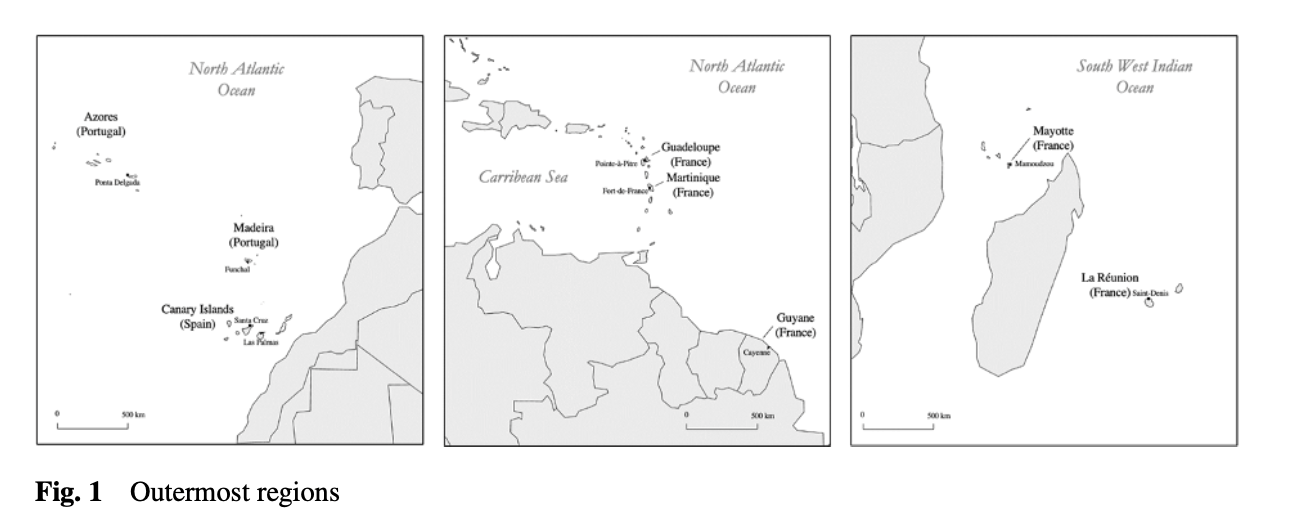
The nine Outermost Regions of the European Union — Guadeloupe, French Guiana, Martinique, Mayotte, La Réunion and Saint-Martin (France), the Azores and Madeira (Portugal), and the Canary Islands (Spain) — share a unique status in EU law. Geographically distant from continental Europe, integrated into their respective regional basins, they have long argued that their specific characteristics require adapted European policies, particularly in research and innovation.
A new study published in the Review of Regional Research fills that gap for the first time. Drawing on CORDIS data across six programming periods — from FP4 to Horizon Europe — researchers from Ruizia and University of La Reunion provide a comprehensive picture of how these nine regions have actually performed. The results are more nuanced, and more encouraging, than the standard narrative suggests.
The findings: heterogeneous, not homogeneous
The dominant institutional discourse has long treated the Outermost Regions as a single bloc, held back equally by distance, small size and structural disadvantage. The data tells a different story.
Participation has grown steadily across all programming periods. EU funding obtained multiplied nearly twentyfold between FP4 and Horizon 2020. Success rates have remained above the EU average. But perhaps most importantly, performance varies enormously across the nine territories. Some regions perform significantly above what their socio-economic profile would predict. Others lag behind structurally comparable continental regions. Geography matters — but it does not determine outcomes uniformly.
The study also challenges the narrative of systematic exclusion from collaborative networks. While "oligarchic" core networks do exist in the Framework Programmes, Outermost Region organisations have been connected to EU champions.
2021: a turning point for Outermost Regions
A key policy development reinforces these findings. Since 2021, Horizon Europe opened its "Widening Participation and Spreading Excellence" component to Outermost Regions — an instrument previously reserved for less advanced national R&I systems. The effect is already visible in the data: 39% of the EU funding obtained by Outermost Regions under Horizon Europe flows through this channel.
This matters. It signals that targeted, adapted instruments can make a difference — and that the Outermost Regions are ready to use them when the door is open.
What this means for the future
The study's conclusions point clearly toward differentiation over uniformity. A single policy framework applied to all nine regions cannot reflect their very different starting points, capacities and trajectories. What is needed — and what the evidence now supports — are tailor-made, evidence-based interventions that address the specific bottlenecks of each territory.
This is precisely the challenge that widerAdvance is working on. As part of its activities on synergies at the regional level, widerAdvance has developed a dedicated Knowledge Valorisation Self-Assessment Tool for managing authorities and policymakers. It allows states and regions — including Outermost Regions — to evaluate their own performance in disseminating and exploiting research results, identify where the gaps lie, and design better-informed policy responses. Built on an analysis of regional diversity across Widening countries and Outermost Regions, it is a practical first step for any territory asking the question: where do we actually stand, and what should we do about it?
Read the full paper: Widening the innovation gap? The outermost regions in the European Research Area
Discover the widerAdvance Knowledge Valorisation Self-Assessment Tool: wideradvance.eu/self-assessment-tool
Authors : Evelyne Tarnus & Philippe Holstein, RUIZIA, La Reunion, France